The chemical element bismuth is classed as an other metal. It was discovered in 1753 by Claude Geoffroy the Younger.

Data Zone
| Classification: | Bismuth is an ‘other metal’ |
| Color: | silver-white |
| Atomic weight: | 208.9804 |
| State: | solid |
| Melting point: | 271.4 oC, 544.5 K |
| Boiling point: | 1564 oC, 1837 K |
| Electrons: | 83 |
| Protons: | 83 |
| Neutrons in most abundant isotope: | 126 |
| Electron shells: | 2,8,18,32,18,5 |
| Electron configuration: | [Xe] 4f14 5d10 6s2 6p3 |
| Density @ 20oC: | 9.807 g/cm3 |
Compounds, Radii, Conductivities
| Atomic volume: | 21.3 cm3/mol |
| Structure: | rhombohedral |
| Hardness: | 2.25 mohs |
| Specific heat capacity | 0.123 J g-1 K-1 |
| Heat of fusion | 11.3 kJ mol-1 |
| Heat of atomization | 207 kJ mol-1 |
| Heat of vaporization | 151 kJ mol-1 |
| 1st ionization energy | 703 kJ mol-1 |
| 2nd ionization energy | 1610 kJ mol-1 |
| 3rd ionization energy | 2466 kJ mol-1 |
| Electron affinity | 91 kJ mol-1 |
| Minimum oxidation number | -3 |
| Min. common oxidation no. | 0 |
| Maximum oxidation number | 5 |
| Max. common oxidation no. | 3 |
| Electronegativity (Pauling Scale) | 2.02 |
| Polarizability volume | 7.4 Å3 |
| Reaction with air | mild, w/ht ⇒ Bi2O3 |
| Reaction with 15 M HNO3 | mild ⇒ Bi(NO3)3, NOx |
| Reaction with 6 M HCl | none |
| Reaction with 6 M NaOH | none |
| Oxide(s) | Bi2O3 |
| Hydride(s) | BiH3 |
| Chloride(s) | BiCl3, BiCl4 |
| Atomic radius | 160 pm |
| Ionic radius (1+ ion) | – |
| Ionic radius (2+ ion) | – |
| Ionic radius (3+ ion) | 117 pm |
| Ionic radius (1- ion) | – |
| Ionic radius (2- ion) | – |
| Ionic radius (3- ion) | – |
| Thermal conductivity | 7.92 W m-1 K-1 |
| Electrical conductivity | 0.867 x 10⁶ S m-1 |
| Freezing/Melting point: | 271.4 oC, 544.5 K |
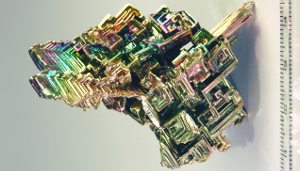
A crystal of bismuth. The colors come from light interference in a thin oxide layer on the surface of the crystal. Image Ref. (1)
Discovery of Bismuth
Bismuth has been known since the fifteenth century.
In 1753, French chemist Claude Geoffroy the Younger established that it was an element in its own right rather than a form of lead.
Bismuth is considered to be stable, although it is actually radioactive with an extremely slow rate of decay.
If precisely 100 grams of bismuth-209 had been present at the beginning of the universe 14 billion years ago, about 99.9999999 grams of it would still be around today.
The name bismuth is probably a latinized version of the old German word for bismuth ‘weissmuth’ meaning ‘white substance’, possibly named after its white oxide.
Appearance and Characteristics
Harmful effects:
Bismuth is not known to be toxic.
Characteristics:
Bismuth is a crystalline, brittle, metal. Lying on the right side of the periodic table, bismuth is the most naturally diamagnetic metal; this means it resists being magnetized and is repelled by a magnetic field. One effect of this can be seen in the video (left).
Bismuth also has unusually high electrical resistance for a metal. Its thermal conductivity is lower than any metal, except mercury.
Bismuth has the unusual property that (like water) it expands as it freezes. Four other elements expand when they freeze: silicon, gallium, antimony and germanium.
Uses of Bismuth
Bismuth is used in medicine (bismuth subnitrate and subcarbonate), cosmetics (bismuth oxychloride), low-melting alloys, fire detection/extinguishing systems, replacement for lead in shot and bullets (bismuth-tin alloy).
Abundance and Isotopes
Abundance earth’s crust: 9 parts per billion by weight, 0.7 parts per billion by moles
Abundance solar system: 10 parts per billion by weight, 0.07 parts per billion by moles
Cost, pure: $39 per 100g
Cost, bulk: $2.83 per 100g
Source: Commercially, bismuth is produced as a byproduct of refining copper, lead, tin, silver, gold, and zinc ores.
Isotopes: Bismuth has 33 isotopes with mass numbers ranging from 185 to 217. Of these only 209Bi is considered to be effectively stable, although it is actually radioactive with an extremely slow rate of alpha particle decay: its half-life is 1.9 x 10¹⁹ years. If precisely 100 grams of 209Bi had been present at the beginning of the universe 14 billion years ago, 99.9999999 grams of it would still be around today.
References
- Photo by Micha L. Rieser
Cite this Page
For online linking, please copy and paste one of the following:
<a href="https://www.chemicool.com/elements/bismuth.html">Bismuth</a>
or
<a href="https://www.chemicool.com/elements/bismuth.html">Bismuth Element Facts</a>
To cite this page in an academic document, please use the following MLA compliant citation:
"Bismuth." Chemicool Periodic Table. Chemicool.com. 15 Oct. 2012. Web. <https://www.chemicool.com/elements/bismuth.html>.
Thank You so much, I chose Bismuth for a science project and without this page I wouldn’t be able to have done it. Thanks!
-Wolfie