The chemical element fermium is classed as an actinide metal. It was discovered in 1952 by teams of scientists led by Albert Ghiorso.

Data Zone
| Classification: | Fermium is an actinide metal |
| Color: | |
| Atomic weight: | (257), no stable isotopes |
| State: | solid |
| Melting point: | 1527 oC, 1800 K |
| Boiling point: | |
| Electrons: | 100 |
| Protons: | 100 |
| Neutrons in most abundant isotope: | 157 |
| Electron shells: | 2,8,18,32,30,8,2 |
| Electron configuration: | [Rn] 5f12 7s2 |
| Density @ 20oC: | 8.84 g/cm3 |
Reactions, Compounds, Radii, Conductivities
| Atomic volume: | 29.1 cm3/mol |
| Structure: | close packed cubic |
| Hardness: | – |
| Specific heat capacity | – |
| Heat of fusion | – |
| Heat of atomization | – |
| Heat of vaporization | – |
| 1st ionization energy | 627 kJ mol-1 |
| 2nd ionization energy | – |
| 3rd ionization energy | – |
| Electron affinity | – |
| Minimum oxidation number | 0 |
| Min. common oxidation no. | 0 |
| Maximum oxidation number | 3 |
| Max. common oxidation no. | 3 |
| Electronegativity (Pauling Scale) | 1.3 |
| Polarizability volume | 23.8 Å3 |
| Reaction with air | |
| Reaction with 15 M HNO3 | |
| Reaction with 6 M HCl | |
| Reaction with 6 M NaOH | |
| Oxide(s) | – |
| Hydride(s) | – |
| Chloride(s) | – |
| Atomic radius | – |
| Ionic radius (1+ ion) | – |
| Ionic radius (2+ ion) | – |
| Ionic radius (3+ ion) | 91.1 pm |
| Ionic radius (1- ion) | – |
| Ionic radius (2- ion) | – |
| Ionic radius (3- ion) | – |
| Thermal conductivity | – |
| Electrical conductivity | – |
| Freezing/Melting point: | 1527 oC, 1800 K |
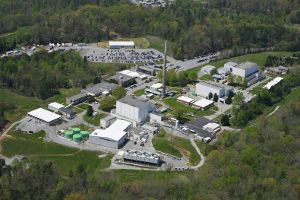
Aerial View of the High Flux Isotope Reactor at Oak Ridge National Laboratory where fermium is produced.
Discovery of Fermium
Fermium was the eighth synthetic transuranium element of the actinide series to be discovered.
Fermium-255 (half-life 20.07 hours) was identified in 1952 by teams of scientists from the Lawrence Berkeley National Laboratory, the Argonne National Laboratory and the Los Alamos Scientific Laboratory. The project was led by Albert Ghiorso.
It was discovered unexpectedly along with einsteinium in debris from the first hydrogen bomb test, codenamed ‘Mike’, which took place in the Pacific on October 31 1952.
The debris was collected on filter papers attached to drone airplanes that flew through the explosion area. Later, to obtain more material, many hundreds of pounds of coral from the blast area were examined.
Fermium was identified by chemical analysis with only about 200 atoms. (1)
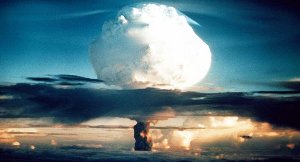
The new element was produced by nuclear fission of 17 neutrons with uranium-238 (which then underwent eight beta decays). (2)
The results were not published and kept secret until 1955.
In 1954 researchers from the Nobel Institute of Physics in Stockholm produced fermium-250 by bombarding uranium-238 with oxygen-16 ions.
The element was named after the nuclear physicist Enrico Fermi.
Appearance and Characteristics
Harmful effects:
Fermium is harmful due to its radioactivity.
Characteristics:
Fermium is a synthetic, highly radioactive metal and has only been produced in miniscule amounts.
Under normal conditions, it behaves in aqueous solution as expected for a trivalent actinide ion.(3)
Fermium metal has not been prepared. (3)
Uses of Fermium
Fermium is of scientific research interest only.
Abundance and Isotopes
Abundance earth’s crust: nil
Abundance solar system: –
Cost, pure: $ per g
Cost, bulk: per 100g
Source: Fermium is a synthetic element and is not found naturally. It is produced in nuclear reactors in miniscule amounts from the neutron bombardment of plutonium by a long series of neutron capture reactions.(2)
Isotopes: Fermium has 18 isotopes whose half-lives are known, with mass numbers 242 to 259. Fermium has no naturally occurring isotopes. Its longest lived isotopes are 257Fm, with a half-life of 100.5 days, 253Fm with a half-life of 3.0 days and 252Fm with a half-life of 25.39 hours.
References
- Glenn T. Seaborg, The Transcalifornium Elements., Journal of Chemical Education, Vol 36.1 (1959) p39.
- Robert E. Krebs, The history and use of our earth’s chemical elements: a reference guide., Greenwood Publishing Group, 2006., p331.
- Robert J. Silva, The Chemistry of the Actinide and Transactinide Elements., Springer., Vol 3.13, p1626-1628.
Cite this Page
For online linking, please copy and paste one of the following:
<a href="https://www.chemicool.com/elements/fermium.html">Fermium</a>
or
<a href="https://www.chemicool.com/elements/fermium.html">Fermium Element Facts</a>
To cite this page in an academic document, please use the following MLA compliant citation:
"Fermium." Chemicool Periodic Table. Chemicool.com. 05 Oct. 2012. Web. <https://www.chemicool.com/elements/fermium.html>.