The chemical element tin is classed as an other metal (white tin) or a nonmetal (gray tin). It has been known since ancient times. Its discoverer and discovery date are unknown.

Data Zone
| Classification: | Tin can behave as an ‘other metal’ (white tin) |
| or a nonmetal (gray tin). | |
| Color: | silvery-white |
| Atomic weight: | 118.69 |
| State: | solid |
| Melting point: | 231.928 oC, 505.078 K |
| Boiling point: | 2620 oC, 2893 K |
| Electrons: | 50 |
| Protons: | 50 |
| Neutrons in most abundant isotope: | 70 |
| Electron shells: | 2,8,18,18,4 |
| Electron configuration: | [Kr] 4d10 5s2 5p2 |
| Density @ 20oC: | 7.30 g/cm3 |
Reactions, Compounds, Radii, Conductivities
| Atomic volume: | 16.3 cm3/mol |
| Structure: | distorted diamond |
| Hardness: | 1.5 mohs |
| Specific heat capacity | 0.227 J g-1 K-1 |
| Heat of fusion | 7.029 kJ mol-1 |
| Heat of atomization | 302 kJ mol-1 |
| Heat of vaporization | 295.80 kJ mol-1 |
| 1st ionization energy | 708.6 kJ mol-1 |
| 2nd ionization energy | 1411.8 kJ mol-1 |
| 3rd ionization energy | 2943 kJ mol-1 |
| Electron affinity | 107 kJ mol-1 |
| Minimum oxidation number | -4 |
| Min. common oxidation no. | 0 |
| Maximum oxidation number | 4 |
| Max. common oxidation no. | 4 |
| Electronegativity (Pauling Scale) | 1.96 |
| Polarizability volume | 7.7 Å3 |
| Reaction with air | mild, w/ht ⇒ SnO2 |
| Reaction with 15 M HNO3 | mild, ⇒ SnO2, NOx |
| Reaction with 6 M HCl | none |
| Reaction with 6 M NaOH | mild, ⇒ H2, [Sn(OH6)]2- |
| Oxide(s) | SnO , SnO2 (stannic oxide) |
| Hydride(s) | SnH4, Sn2H6 |
| Chloride(s) | SnCl2 & SnCl4 |
| Atomic radius | 140.5 pm |
| Ionic radius (1+ ion) | – |
| Ionic radius (2+ ion) | – |
| Ionic radius (3+ ion) | – |
| Ionic radius (1- ion) | – |
| Ionic radius (2- ion) | – |
| Ionic radius (3- ion) | – |
| Thermal conductivity | 66.8 W m-1 K-1 |
| Electrical conductivity | 8.7 x 10⁶ S m-1 |
| Freezing/Melting point: | 231.928 oC, 505.078 K |
Discovery of Tin
Tin has been known since ancient times. We do not know who discovered it.
The Bronze Age began in about 3000 BC and tin was used in bronze, which contains roughly ninety percent copper and ten percent tin.
The addition of tin to bronze alloys improves their properties compared with pure copper: for example, bronze is harder and more easily cast than copper.
The ancient Greeks obtained their tin by sea-trade and referred to the source as ‘The Cassiterides’, meaning Tin Islands.
These islands were most likely to have been in Cornwall, Great Britain and/or north-west Iberia, Spain where there are large tin deposits.
In less ancient times, British scientist Robert Boyle published a description of his experiments on the oxidation of tin in 1673.
Tin’s chemical symbol, Sn, comes from its Latin name, ‘stannum.’
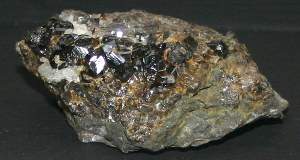
Crystals of cassiterite – SnO2 – tin ore (Photo by Chris Ralph)

Solder can be used to secure electronic components. Solder is usually about 60% tin and 40% lead. Here solder is being removed from a circuit board. Image by Hugo.
Appearance and Characteristics
Harmful effects:
Tin is considered to be non-toxic but most tin salts are toxic. The inorganic salts are caustic but of low toxicity. Organometallic compounds of tin are highly toxic.
Characteristics:
Tin is a silvery-white, soft, malleable metal that can be highly polished.
Tin has a highly crystalline structure and when a tin bar is bent, a ‘tin cry’ is heard, due to the breaking of these crystals.
In compounds tin is usually in the divalent state (Sn2+) or tetravalent state (Sn4+).
It resists oxygen and water but dissolves in acids and bases. Exposed surfaces form an oxide film. When heated in air, tin forms tin(IV) oxide (stannic oxide) which is feebly acidic.
Tin has two allotropic forms at normal pressure, gray tin and white tin. Pure white tin slowly tends to become the gray powder (gray tin), a change commonly called ‘tin pest’ at temperatures below 13.2 oC. Gray tin has no metallic properties at all. Commercial quality tins are resistant to tin pest as a result of the inhibiting effects of minor impurities.
Uses of Tin
Tin is used as a coating on the surface of other metals to prevent corrosion. ‘Tin’ cans, for example, are made of tin-coated steel.
Tin can be rolled into thin foil sheets (tinfoil). Present day ‘tinfoil’ to cover or wrap food is usually made from aluminum.
Alloys of tin are commercially important in, for example, soft solder, pewter, bronze and phosphor bronze.
Tin chloride (stannous chloride, SnCl2) is used as a mordant in dyeing textiles and for increasing the weight of silk.
Stannous fluoride (SnF2) is used in some toothpastes.
Abundance and Isotopes
Abundance earth’s crust: 2.3 parts per million by weight, 0.4 parts per million by moles
Abundance solar system: 9 parts per billion by weight, 0.1 parts per billion by moles
Cost, pure: $24 per 100g
Cost, bulk: $1.80 per 100g
Source: Tin very rarely occurs free in nature. The chief ore is cassiterite (SnO2). The metal is prepared from cassiterite by reducing the ore with coal.
Isotopes: Tin has 35 isotopes whose half-lives are known, mass numbers 100 to 134. Tin has ten stable isotopes, the most of any element.
Naturally occurring tin is a mixture of its ten stable isotopes and they are found in the percentages shown: 112Sn (1.0%), 114Sn (0.7%), 115Sn (0.3%), 116Sn (14.5%), 117Sn (7.7%), 118Sn (24.2%), 119Sn (8.6%), 120Sn (32.6%), 122Sn (4.6%) and 124Sn (5.8%). The most abundant is 120Sn at 32.6%.
References
Cite this Page
For online linking, please copy and paste one of the following:
<a href="https://www.chemicool.com/elements/tin.html">Tin</a>
or
<a href="https://www.chemicool.com/elements/tin.html">Tin Element Facts</a>
To cite this page in an academic document, please use the following MLA compliant citation:
"Tin." Chemicool Periodic Table. Chemicool.com. 24 Jul. 2015. Web. <https://www.chemicool.com/elements/tin.html>.
I wish it would contain more random facts, helping students trying to research
this website is very informative and helped me a lot.
This web site rocks! It gives so much information and helped me soooo soooo much.