The chemical element samarium is classed as a lanthanide and rare earth metal. It was discovered in 1853 by Jean Charles Galissard de Marignac.

Data Zone
| Classification: | Samarium is a lanthanide and rare earth metal |
| Color: | silvery-white |
| Atomic weight: | 150.4 |
| State: | solid |
| Melting point: | 1170 oC, 1443 K |
| Boiling point: | 1790 oC, 2063 K |
| Electrons: | 62 |
| Protons: | 62 |
| Neutrons in most abundant isotope: | 90 |
| Electron shells: | 2,8,18,24,8,2 |
| Electron configuration: | [Xe] 4f6 6s2 |
| Density @ 20oC: | 7.54 g/cm3 |
Reactions, Compounds, Radii, Conductivities
| Atomic volume: | 20.0 cm3/mol |
| Structure: | close packed (ABCBCACAB) |
| Specific heat capacity | 0.20 J g-1 K-1 |
| Heat of fusion | 8.62 kJ mol-1 |
| Heat of atomization | 207 kJ mol-1 |
| Heat of vaporization | 191.63 kJ mol-1 |
| 1st ionization energy | 543.3 kJ mol-1 |
| 2nd ionization energy | 1068 kJ mol-1 |
| 3rd ionization energy | 2260 kJ mol-1 |
| Electron affinity | – |
| Minimum oxidation number | 0 |
| Min. common oxidation no. | 0 |
| Maximum oxidation number | 3 |
| Max. common oxidation no. | 3 |
| Electronegativity (Pauling Scale) | 1.17 |
| Polarizability volume | 28.8 Å3 |
| Reaction with air | mild, ⇒ Sm2O3 |
| Reaction with 15 M HNO3 | mild, ⇒ Sm(NO3)3 |
| Reaction with 6 M HCl | mild, ⇒ H2, SmCl3 |
| Reaction with 6 M NaOH | – |
| Oxide(s) | SmO, Sm2O3 (samaria) |
| Hydride(s) | SmH2, SmH3 |
| Chloride(s) | SmCl2, SmCl3 |
| Atomic radius | 185 pm |
| Ionic radius (1+ ion) | – |
| Ionic radius (2+ ion) | 136 pm |
| Ionic radius (3+ ion) | 109.8 pm |
| Ionic radius (1- ion) | – |
| Ionic radius (2- ion) | – |
| Ionic radius (3- ion) | – |
| Thermal conductivity | 13.3 W m-1 K-1 |
| Electrical conductivity | 1.1 x 10⁶ S m-1 |
| Freezing/Melting point: | 1170 oC, 1443 K |
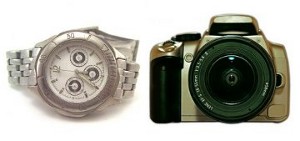
Samarium-cobalt magnets are used in quartz watches and in camera shutters. (3)
Discovery of Samarium
In 1853, in Geneva, Switzerland, chemist Jean Charles Galissard de Marignac discovered samarium when he found lines in mineral spectra he was studying that matched no known element.
Paul-Émile Lecoq de Boisbaudran isolated a samarium salt in 1879, in Paris.
First, Boisbaudran extracted ‘didymium’ from the mineral samarskite and made a solution of ‘didymium’ nitrate. He then added ammonium hydroxide and found two precipitates were formed; one containing ‘didymium’ and the other a new element – samarium. (1),(2)
We should bear in mind that ‘didymium’ had been incorrectly identified as a new element by Carl Mosander in 1841.
‘Didymium’ was even given the symbol Di in Mendeleev’s first edition of the periodic table in 1869.
It wasn’t until 1885 that Carl Auer von Welsbach established that ‘didymium’ was actually composed of two distinct, new elements: neodymium and praseodymium.
The new element samarium was named after the mineral samarskite in which it had been found. (The mineral samarskite had been named in 1847 by mineralogist Heinrich Rose after a Russian mine official, Vasili Samarsky-Bykhovets, who had given him a sample of it.)
In addition to samarium, Lecoq discovered gallium in 1875 and he went on to isolate gadolinium in 1885 and dysprosium in 1886.
In 1901 Eugène-Antole Demarçay found that Lecoq’s samarium was impure and he successfully isolated europium magnesium nitrate from a sample of samarium magnesium nitrate. (1)

Samarium is used in headphones, iPods and guitar pickups.
Appearance and Characteristics
Harmful effects:
Samarium is considered to be moderately toxic.
Characteristics:
Samarium is a bright, fairly hard, silvery white metal. It is one of the lanthanide rare earth metals.
It is stable in air at normal temperatures, but ignites in air when the temperature is 150 oC or higher. In moist air it tarnishes to the oxide.
In its compounds Samarium usually exists as a trivalent ion, Sm3+. Most of its salts are pale yellow in color.
Uses of Samarium
Samarium’s main use is in samarium-cobalt alloy magnets for headphones, small motors and pickups for some electric guitars. These magnets have a high resistance to demagnetization. They keep their ferromagnetism at temperatures up to 700 oC. (3) As a result of their ability to operate at high temperatures, SmCo magnets are used in precision-guided weapons.
Samarium oxide (samaria) is used as a catalyst for the dehydration and dehydrogenation of ethanol. Samarium oxide is also used in infrared absorbing glass.
Radioactive 153Sm is used in the treatment of cancers.
Samarium is also used as an absorber in nuclear reactors.
Abundance and Isotopes
Abundance earth’s crust: 6 parts per million by weight, 0.8 parts per million by moles
Abundance solar system: 1 part per billion by weight, 10 parts per trillion by moles
Cost, pure: $360 per 100g
Cost, bulk: $ per 100g
Source: Samarium is not found free in nature but is found in a number of minerals mainly monazite and bastnaesite. Commercially, it is recovered from monazite sand and bastnaesite using ion exchange and solvent extraction techniques. Samarium metal can be produced by electrolysis of the molten chloride with sodium chloride.
Isotopes: Samarium has 30 isotopes whose half-lives are known, with mass numbers 131 to 160. Naturally occurring samarium is a mixture of seven isotopes and they are found in the percentages shown: 144Sm (3.1%), 147Sm (15.0%), 148Sm (11.2%), 149Sm (13.8%), 150Sm (7.4%), 152Sm (26.7%) and 154Sm (22.8%). The most abundant isotope is 152Sm at 26.7%.
References
- Ferenc Szabadváry, Handbook of the Chemistry and Physics of the Rare Earths Vol. 11., Elsevier Science Publishers., 1998, p52 and p62.
- John Emsley, Nature’s building blocks: an A-Z guide to the elements., Oxford University Press, 2003, p372.
- Per Enghag, Encyclopedia of the elements: technical data, history, processing, applications., John Wiley and Sons, 2004, page 485.
- Photo: LLNL
Cite this Page
For online linking, please copy and paste one of the following:
<a href="https://www.chemicool.com/elements/samarium.html">Samarium</a>
or
<a href="https://www.chemicool.com/elements/samarium.html">Samarium Element Facts</a>
To cite this page in an academic document, please use the following MLA compliant citation:
"Samarium." Chemicool Periodic Table. Chemicool.com. 18 Oct. 2012. Web. <https://www.chemicool.com/elements/samarium.html>.
Great info. Helped me on my project on samarium.