The chemical element phosphorus is classed as a nonmetal. It was discovered in 1669 by Hennig Brand.

Data Zone
| Classification: | Phosphorus is a nonmetal |
| Color: | White phosphorus is usually pale yellow |
| Atomic weight: | 30.97376 |
| State: | solid |
| Melting point: | 44.2 oC, 317.3 K |
| Boiling point: | 280.5 oC, 553.7 K |
| Electrons: | 15 |
| Protons: | 15 |
| Neutrons in most abundant isotope: | 16 |
| Electron shells: | 2,8,5 |
| Electron configuration: | 1s2 2s2 2p6 3s2 3p3 |
| Density @ 20oC: | 1.82 g/cm3 |
Reactions, Compounds, Radii, Conductivities
| Atomic volume: | 17.0 cm3/mol |
| Structure: | P4 tetrahedral arrangement (white phosphorus) |
| Hardness: | 0.5 mohs |
| Specific heat capacity | 0.77 J g-1 K-1 |
| Heat of fusion | 0.657 kJ mol-1 |
| Heat of atomization | 315 kJ mol-1 |
| Heat of vaporization | 12.129 kJ mol-1 |
| 1st ionization energy | 1011.7 kJ mol-1 |
| 2nd ionization energy | 1903.2 kJ mol-1 |
| 3rd ionization energy | 2911.9 kJ mol-1 |
| Electron affinity | 72.07 kJ mol-1 |
| Minimum oxidation number | -3 |
| Min. common oxidation no. | -3 |
| Maximum oxidation number | 5 |
| Max. common oxidation no. | 5 |
| Electronegativity (Pauling Scale) | 2.19 |
| Polarizability volume | 3.6 Å3 |
| Reaction with air | vigorous, ⇒ P4O10 ignites |
| Reaction with 15 M HNO3 | mild, ⇒ NOx |
| Reaction with 6 M HCl | none |
| Reaction with 6 M NaOH | mild, ⇒ PH3 (phosphine) may ignite |
| Oxide(s) | P4O10, P4O6 |
| Hydride(s) | PH3, P2H4 + more |
| Chloride(s) | PCl3, PCl5, P2Cl4 |
| Atomic radius | 100 pm |
| Ionic radius (1+ ion) | – |
| Ionic radius (2+ ion) | – |
| Ionic radius (3+ ion) | 58 pm |
| Ionic radius (1- ion) | – |
| Ionic radius (2- ion) | – |
| Ionic radius (3- ion) | – |
| Thermal conductivity | 0.24 W m-1 K-1 |
| Electrical conductivity | 1.0 x 10⁻¹⁰ S m-1 |
| Freezing/Melting point: | 44.2 oC, 317.3 K |
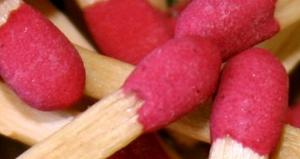
Red phosphorus enables matches to strike.
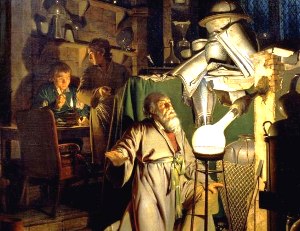
Hennig Brand discovers phosphorus. The white phosphorus is glowing with exaggerated intensity. White phosphorus’s natural chemiluminescence produces a rather dim green glow. “The Alchymist, In Search of the Philosopher’s Stone.” Painted by Joseph Wright in 1771.
Discovery of Phosphorus
Hennig Brand discovered phosphorus in 1669, in Hamburg, Germany, preparing it from urine. (Urine naturally contains considerable quantities of dissolved phosphates.)
Brand called the substance he had discovered ‘cold fire’ because it was luminous, glowing in the dark.
Brand was an alchemist and, like other alchemists, he was secretive about his methods.
He did not reveal his method publicly, choosing instead to sell it to Johann Daniel Kraft and Kunckel von Lowenstern.(1)
For further payment he also revealed his secret to Gottfried Wilhelm Leibniz, better known for discovering calculus independently of Isaac Newton.
Leibniz, also thinking as an alchemist, mistakenly believed Brand might be able to discover the philosophers’ stone by producing a large quantity of phosphorus.(1)
Brand’s method is believed to have consisted of evaporating urine to leave a black residue that was then left for a few months. The residue was then heated with sand, driving off a variety of gases and oils which were condensed in water.
The final substance to be driven off, condensing as a white solid, was phosphorus.(2)
This was a typically alchemical method – alchemists examined the properties of body fluids, hoping to better understand living things in their search for the philosophers’ stone, which they believed offered the prospect of eternal life.
Brand’s method became more widely known in 1737 when an unknown person sold it to the Academy of Sciences in Paris.
Phosphorus was produced by this method until the 1770s when Swedish scientist Carl Wilhelm Scheele – the discoverer of chlorine and one of oxygen‘s independent discoverers – found that phosphorus could be prepared from bone.(3)
The name comes from the Greek word ‘phosphoros’ meaning bringer of light.
Interesting Facts about Phosphorus
- When Hennig Brand discovered phosphorus, he became the first person in history to discover an element. (Of course, other elements such as gold and silver were already known – but they had no named discoverer.) The case is similar to the discovery of Uranus by William Herschel in 1781. Other planets had been known for thousands of years, but Herschel was the first person to see and identify Uranus as a new planet.
- Phosphorus compounds are vital for life. Phosphorus is the sixth most abundant element in living organisms. (Now try guessing which elements are more abundant – no search engines allowed until you’ve thought of your own answer!)
- In The Hound of the Baskervilles, Dr Watson concluded that the hound had been made to look more terrifying by the ghostly glow of phosphorus, or, since this would most likely have killed the hound, “A cunning preparation of it,” according to Sherlock Holmes.
- White phosphorus ignites spontaneously in air. Red phosphorus needs friction to ignite it, hence its use in matches. Red phosphorus is made by heating white phosphorus to 300 oC in the absence of air.
Appearance and Characteristics
Harmful effects:
White phosphorus is highly toxic. Skin contact can result in severe burns. Red phosphorus (provided it is not contaminated with white phosphorus) is considered non-toxic.
Characteristics:
White phosphorus is a highly reactive, waxy, white-yellow, transparent solid with acrid fumes. It emits a weak green glow (luminescence) in the presence of oxygen. It is insoluble in water, but soluble in carbon disulfide. White phosphorus ignites spontaneously in air, burning to the pentoxide (P4O10).
Phosphorus exists in two other main allotropic forms: red, and black (or violet).
Red phosphorus results when white phosphorus is heated or exposed to sunlight.
Black phosphorus is the least reactive allotrope and has a graphite-like structure.
Uses of Phosphorus
Phosphorus is a vital plant nutrient and its main use – via phosphate compounds – is in the production of fertilizers. Just as there are biological carbon and nitrogen cycles, there is also a phosphorus cycle.
Phosphorus is used in the manufacture of safety matches (red phosphorus), pyrotechnics and incendiary shells.
Phosphorus is also used in steel manufacture and in the production of phosphor bronze.
Phosphates are ingredients of some detergents.
Phosphorus is used to make light-emitting diodes (LEDs).
Abundance and Isotopes
Abundance earth’s crust: 1,050 parts per million by weight, 730 parts per million by moles
Abundance solar system: 7 parts per million by weight, 300 parts per billion by moles
Cost, pure: $30 per 100g
Cost, bulk: $ per 100g
Source: Phosphorus does not occur as a free element in nature, but it is found in many different minerals. It is produced commercially from calcium phosphate (phosphate rock): calcium phosphate is heated in a furnace with silica and carbon to produce vaporized tetraphosphorus, which is then condensed into phosphorus as a white powder under water to prevent oxidation.
Isotopes: Phosphorus has 18 isotopes whose half-lives are known, with mass numbers 26 to 43. Naturally occurring phosphorus consists of its one stable isotope, 31P.
References
- Mary Elvira Weeks, The discovery of the elements. XXI. Supplementary note on the discovery of phosphorus J. Chem. Educ., 1933, 10 (5), p 302.
- Mary Elvira Weeks, The discovery of the elements. II. Elements known to the alchemists J. Chem. Educ., 1932, 9 (1), p 11.
- Antoine Lavoisier, Elements of Chemistry
Cite this Page
For online linking, please copy and paste one of the following:
<a href="https://www.chemicool.com/elements/phosphorus.html">Phosphorus</a>
or
<a href="https://www.chemicool.com/elements/phosphorus.html">Phosphorus Element Facts</a>
To cite this page in an academic document, please use the following MLA compliant citation:
"Phosphorus." Chemicool Periodic Table. Chemicool.com. 17 Oct. 2012. Web. <https://www.chemicool.com/elements/phosphorus.html>.
What are three different examples of compounds that Phosphorus is used to create?
Have a look in the data zone at the top of the page.
P4O10, P4O6, PH3, P2H4, PCl3, PCl5, P2Cl4.
Phospholipids are an example.
I am doing an adopt an element project for school. This website was very helpful. Thank you so much!!!
i agree with puppy love this website was very helpful