The chemical element livermorium is classed as an other metal. It was discovered in 2000 by by science teams led by Yuri Oganessian and Ken Moody.

Data Zone
| Classification: | Livermorium is an ‘other metal’ (presumed) |
| Color: | |
| Atomic weight: | (293), no stable isotopes |
| State: | solid (presumed) |
| Melting point: | |
| Boiling point: | |
| Electrons: | 116 |
| Protons: | 116 |
| Neutrons in most abundant isotope: | 177 |
| Electron shells: | 2, 8, 18, 32, 32, 18, 6 |
| Electron configuration: | [Rn] 5f14 6d10 7s2 7p4 |
| Density @ 20oC: |
Reactions, Compounds, Radii, Conductivities
| Atomic volume: | – |
| Structure: | – |
| Hardness: | – |
| Specific heat capacity | – |
| Heat of fusion | – |
| Heat of atomization | – |
| Heat of vaporization | – |
| 1st ionization energy | – |
| 2nd ionization energy | – |
| 3rd ionization energy | – |
| Electron affinity | – |
| Minimum oxidation number | – |
| Min. common oxidation no. | – |
| Maximum oxidation number | – |
| Max. common oxidation no. | – |
| Electronegativity (Pauling Scale) | – |
| Polarizability volume | – |
| Reaction with air | – |
| Reaction with 15 M HNO3 | – |
| Reaction with 6 M HCl | – |
| Reaction with 6 M NaOH | – |
| Oxide(s) | – |
| Hydride(s) | – |
| Chloride(s) | – |
| Atomic radius | – |
| Ionic radius (1+ ion) | – |
| Ionic radius (2+ ion) | – |
| Ionic radius (3+ ion) | – |
| Ionic radius (1- ion) | – |
| Ionic radius (2- ion) | – |
| Ionic radius (3- ion) | – |
| Thermal conductivity | – |
| Electrical conductivity | – |
| Freezing/Melting point: |
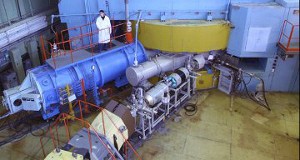
The heavy ion cyclotron U-400 in Dubna, where livermorium was synthesized. Image by Jim Roberto, Oak Ridge National Laboratory
Discovery of Livermorium
Element 116, livermorium, was first made in Dubna, Russia in July 2000. The work was a collaboration between science teams at the Joint Institute for Nuclear Research in Dubna and the Lawrence Livermore National Laboratory in California led by Yuri Oganessian and Ken Moody.
The International Union of Pure and Applied Chemistry (IUPAC) reviewed the work over a period of years and in 2011 finally accepted the discovery of ununhexium, as it was called at the time. (1)
The reaction was a fusion of element 20 with element 96: calcium-48 with curium-248. Calcium ions were formed into a beam in a cyclotron (a particle accelerator) and fired at a curium target.
In the first instance a single atom of livermorium-292 was detected. It existed for 46.9 ms before undergoing alpha-decay to flerovium-288. (1)
In an experiment that lasted a year, two further atoms of livermorium-292 were made. The first existed for 125.5 ms and the second for 55.0 ms. By the end of the experiment a total of 2.3 x 10¹⁹ calcium ions had been fired at the curium target. (2) By 2005, 30 atoms of livermorium had been made.
As a result of its position in Group 16 of the periodic table, livermorium is expected to be classed as one of the ‘other metals’ and/or to have similar properties to the metalloid polonium. Too little of the element has been synthesized for this to be confirmed.
Ununhexium (Uuh) was element 116’s temporary name until an official name was chosen by IUPAC. In 2012, IUPAC approved that element 116 should be named livermorium with the symbol Lv.
The deputy director of Russia’s Joint Institute for Nuclear Research (JINR) initially wanted element 116’s name to be derived from Muscovy, in honor of the Moscow region. (3) Subsequently, the name livermorium was chosen to honor the work carried out by the scientists from the Lawrence Livermore National Laboratory in California in the discovery of the superheavy elements.
IUPAC has accepted the discoveries of:
- element 113 (nihonium)
- element 114 (flerovium)
- element 115 (moscovium)
- element 116 (livermorium)
- element 117 (tennessine)
- element 118 (oganesson)
thus completing the seventh row of the periodic table.
Appearance and Characteristics
Harmful effects:
Livermorium is harmful due to its radioactivity.
Characteristics:
Livermorium is a synthetic radioactive metal and has only been produced in minute amounts.
Uses of Livermorium
Livermorium is of research interest only.
Abundance and Isotopes
Abundance earth’s crust: nil
Abundance solar system: parts per trillion by weight, parts per trillion by moles
Cost, pure: $ per 100g
Cost, bulk: $ per 100g
Source: Livermorium is a synthetic radioactive metal, created via nuclear bombardment, and has only been produced in minute amounts. Livermorium is produced by bombarding 248Cm with 48Ca.
Isotopes: Livermorium has 4 isotopes whose half-lives are known, with mass numbers from 290 to 293. None are stable. The most stable isotope is 293Lv, with a half-life of about 61 milliseconds.
References
- Robert Barber, Paul Karol, Hiromichi Nakahara, Emanuele Vardaci, and Erich Vogt, Discovery of the elements with atomic numbers greater than or equal to 113,. 2011, IUPAC. (pdf download)
- J. B. Patin et al., Confirmed results of the 248Cm(48Ca,4n)292116 experiment., November 19, 2003. (pdf download)
- New chemical elements synthesized by Russian team recognized., June 3, 2011, RIA Novosti.
Cite this Page
For online linking, please copy and paste one of the following:
<a href="https://www.chemicool.com/elements/livermorium.html">Livermorium</a>
or
<a href="https://www.chemicool.com/elements/livermorium.html">Livermorium Element Facts</a>
To cite this page in an academic document, please use the following MLA compliant citation:
"Livermorium." Chemicool Periodic Table. Chemicool.com. 11 Jun. 2016. Web. <https://www.chemicool.com/elements/livermorium.html>.