The chemical element oganesson is classed is a noble gas. It was discovered in 2002 by research scientists at the Joint Institute for Nuclear Research in Dubna, Russia and the Lawrence Livermore National Laboratory (LLNL), California.

Data Zone
| Classification: | Oganesson is a noble gas |
| (or a noble solid?) and a nonmetal | |
| Atomic weight: | (294), no stable isotopes |
| State: | gas (presumed) |
| Melting point: | |
| Boiling point: | |
| Electrons: | 118 |
| Protons: | 118 |
| Neutrons in most abundant isotope: | 176 |
| Electron shells: | 2, 8, 18, 32, 32, 18, 8 |
| Electron configuration: | [Rn] 5f14 6d10 7s2 7p6 (presumed) |
Reactions, Compounds, Radii, Conductivities
| Specific heat capacity | – |
| Heat of fusion | – |
| Heat of atomization | – |
| Heat of vaporization | – |
| 1st ionization energy | – |
| 2nd ionization energy | – |
| 3rd ionization energy | – |
| Electron affinity | – |
| Minimum oxidation number | – |
| Min. common oxidation no. | – |
| Maximum oxidation number | – |
| Max. common oxidation no. | – |
| Electronegativity (Pauling Scale) | – |
| Polarizability volume | – |
| Reaction with air | – |
| Reaction with 15 M HNO3 | – |
| Reaction with 6 M HCl | – |
| Reaction with 6 M NaOH | – |
| Oxide(s) | – |
| Hydride(s) | – |
| Chloride(s) | – |
| Atomic radius | – |
| Ionic radius (1+ ion) | – |
| Ionic radius (2+ ion) | – |
| Ionic radius (3+ ion) | – |
| Ionic radius (1- ion) | – |
| Ionic radius (2- ion) | – |
| Ionic radius (3- ion) | – |
| Thermal conductivity | – |
| Electrical conductivity | – |
| Freezing/Melting point: | – |
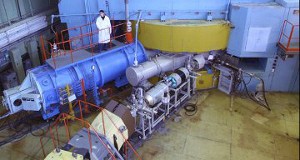
The heavy ion cyclotron U-400 in Dubna, where oganesson was synthesized.
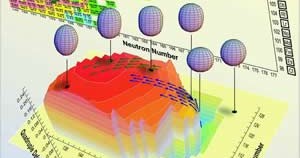
A combination of experiments and computer simulations enable predictions to be made of deformations and shapes of the heaviest elements in and beyond the current periodic table. Image Ref. (2)
Discovery of Oganesson
Research scientists at the Joint Institute for Nuclear Research in Dubna, Russia and the Lawrence Livermore National Laboratory (LLNL), California first made element 118, oganesson, in 2002.
The reaction was a fusion of element 20 with element 98: calcium-48 with californium-249.
Calcium ions were formed into a beam in a cyclotron (a particle accelerator) and fired at a target layer of californium oxide deposited on titanium foil.
Bombardment lasted 2300 hours, accumulating a total dose of 2.5 x 10¹⁹ calcium ions.
Two atoms of oganesson-294, which existed for 2.55 ms and 3.16 ms, were produced in March 2002. (1)
Further experiments and analysis later confirmed this result and the discovery was verified by The International Union of Pure and Applied Chemistry (IUPAC) in 2015.
The report stated, “The claim of the Dubna–Livermore 2006 collaboration for discovery of the element with atomic number Z=18 is acknowledged as validated..”
As a result of its position in the periodic table oganesson is expected to be classed as a noble gas.
The element is named after the Russian Professor Yuri Oganessian, for his pioneering contributions to transactinoid elements research.
IUPAC has accepted the discoveries of:
- element 113 (nihonium)
- element 114 (flerovium)
- element 115 (moscovium)
- element 116 (livermorium)
- element 117 (tennessine)
- element 118 (oganesson)
thus completing the seventh row of the periodic table.
Appearance and Characteristics
Harmful effects:
Oganesson is harmful due to its radioactivity.
Characteristics:
Oganesson is a synthetic radioactive metal and has only been produced in minute amounts.
Uses of Oganesson
Oganesson is of research interest only.
Abundance and Isotopes
Abundance earth’s crust: nil
Abundance solar system: parts per trillion by weight, parts per trillion by moles
Cost, pure: $ per 100g
Cost, bulk: $ per 100g
Source: A few atoms oganesson have been created via nuclear bombardment of 249Cf with 48Ca ions in a heavy ion accelerator.
Isotopes: Oganesson has one isotope whose half-life is known very approximately: 294Og, with a half-life of 0.89 milliseconds.
References
- Oganessian et al., Results of the first 249Cf + 48Ca Experiment. (pdf download)
- Photo: ORNL
Cite this Page
For online linking, please copy and paste one of the following:
<a href="https://www.chemicool.com/elements/ununoctium.html">Oganesson</a>
or
<a href="https://www.chemicool.com/elements/ununoctium.html">Oganesson Element Facts</a>
To cite this page in an academic document, please use the following MLA compliant citation:
"Oganesson." Chemicool Periodic Table. Chemicool.com. 16 Jun. 2016. Web. <https://www.chemicool.com/elements/ununoctium.html>.
I love this website it totally helps with school work!!! Thanks!! <3
You had to do school work on oganesson?!